What Brand Voice Actually Is (and Isn’t)
Brand voice is not your logo. It’s not your color palette. It’s not your company tagline.
Brand voice is the personality that comes through in every word you write. It’s recognizable. If your product description appeared without a brand name, your customer should think, “That sounds like them.”
For Shopify stores, brand voice lives in product descriptions. It lives in button labels, error messages, and email copy. It’s the cumulative feeling of how you talk about what you sell.
Why does this matter? Because your product descriptions are not search engine filler. They’re your chance to tell the shopper why they should care about this product. And they’ll only care if the voice feels authentic and makes them feel understood.
A luxury skincare brand writes like this: “Formulated with French sea water and retinol complex, this serum is for the refined routine.” A playful pet supply brand writes like this: “Treat every walk like you own the place. This harness comes with our ‘no-more-lunges’ promise.” Same product category, opposite voices. One works for the customer who cares about precision. One works for the customer who wants permission to be silly about their dog.
You need a voice that works for your people.
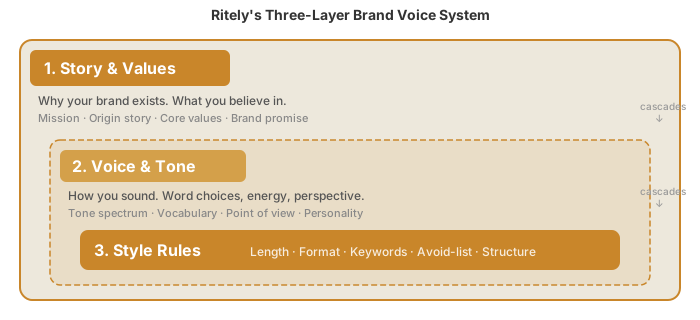
The Four Dimensions of Brand Voice
Brand voice exists on four spectrums. Every store sits somewhere on each one. Your job is to pinpoint where you sit and stay consistent.
1. Tone (Formal to Casual)
Spectrum: Formal (“We recommend”) to Casual (“Just grab this”)
Tone is how you sound in the moment. It’s the emotional temperature. Are you speaking down to someone? Across to them as a peer? Up to them with reverence?
A formal tone uses complete sentences, measured language, and emotional distance. “This product features advanced moisture retention technology.” A casual tone uses contractions, shorter sentences, and warmth. “Moisturizes like nobody’s business.”
Most Shopify stores sit in the middle. But if your customers are other businesses, you skew formal. If your customers are twenty-something enthusiasts buying hobby gear, you skew casual.
Formality isn’t about intelligence. It’s about whether the customer expects professional authority or a friend who gets it.
2. Formality (Technical to Conversational)
Spectrum: Technical (specs, jargon, precision) to Conversational (benefits, everyday language, feeling)
This is different from tone. You can be casually technical. “Yep, we used a 500-thread-count Egyptian cotton and it sleeps cool.” You can be formally conversational. “We selected this coffee for its bright acidity and chocolate notes.”
Formality is about whether you explain what something is or how it feels. Technical voices describe ingredients, specs, processes. Conversational voices describe results, experiences, moments.
An automotive brand writing about a tire will lean technical: compounds, tread patterns, load ratings. A clothing brand writing about the same comfort level will lean conversational: “Moves with you, doesn’t fight back.”
Neither is wrong. But they’re different promises to different customers.
3. Vocabulary (Industry Jargon to Plain Language)
Spectrum: Jargon-heavy (your customer is an expert) to Plain language (accessibility is a feature)
Some customers want jargon. They’re buying professional equipment. Jargon signals that you understand their world. Other customers actively avoid it. They’re buying something they don’t know much about and they want clarity without feeling stupid.
A fitness supplement brand aimed at competitive athletes will say, “Enhanced HMB bioavailability improves lean mass retention during caloric deficit.” A general wellness brand will say, “Helps keep your muscles strong while you’re losing weight.”
If you use jargon your customer doesn’t understand, they’ll think the jargon is covering something up. If you avoid jargon your expert customer is expecting, you’ll sound condescending or uninformed.
Know your customer’s vocabulary level and meet them there.
4. Perspective (Feature-First to Benefit-First)
Spectrum: What it is (ingredients, specs, design) to What it does (outcomes, experiences, transformations)
Feature-first voices lead with the thing. “This jacket has a three-layer Gore-Tex laminate, sealed seams, and adjustable hood.” Benefit-first voices lead with the result. “You’ll stay dry in a downpour and not overheat when you stop.”
Some customers are researchers. They want to understand what they’re buying so they can evaluate it. Feature-first works. Other customers are solution-seekers. They want to know if this solves their problem. Benefit-first works.
Most strong brands use both, but with a hierarchy. A technical brand puts features first, then mentions benefits. A lifestyle brand puts benefits first, then mentions features for the curious.
Your perspective tells the customer whether you trust them to care about how it works, or whether you care more about whether it works.
The Brand Voice Worksheet
Answer the following questions honestly. This isn’t about who you want to sound like. It’s about who you actually are and what your customers expect.
About Your Customer
Who is this store for? The person actually buying from you, not the aspirational buyer.
- What’s their age range and lifestyle?
- What do they already know about your category? (Expert, familiar, beginner, clueless?)
- What problem does your product solve for them?
- How do they talk about that problem in real life? (Not how marketers talk about it.)
- What emotional need does your product meet? (Status? Comfort? Time savings? Joy?)
Tone Check
Read these descriptions of the same backpack. Which one sounds like your brand?
Option A: “This pack is where adventure meets organization. Fifteen compartments, weatherproof zips, and a laptop sleeve that actually fits. Throw it on and go.”
Option B: “Constructed from 1000D Cordura ballistic nylon with YKK #5 marine-grade zippers and a padded laptop compartment designed to accommodate devices up to 17 inches.”
Option C: “The Expedition Pro contains all essential organizational features required for extended field use, including weather-sealed closures and modular attachment points.”
A is casual. B is casual but technical. C is formal. Where’s yours?
Formality Check
For a product you actually sell, how would you describe the main benefit?
Write two versions. One that leads with the feature (formality). One that leads with the feeling (conversational). Which one matches how you talk about your products?
Vocabulary Baseline
Write a product description for something in your store without using any technical jargon. Now write the same description assuming your customer is an expert in this category. Which version matches your actual customer?
Your Brand Story
Why did you start this store? Not the marketing version. The real reason.
That reason lives in your voice. A founder who started a sustainable fashion brand because she was tired of throwing away cheap clothes will write differently than a founder who’s chasing a trend. Your customer can feel the difference.
Writing Your Brand Voice Statement
Now distill your answers into a usable guide. You’re not writing marketing copy. You’re writing instructions for anyone (or any AI) writing on behalf of your brand.
Your brand voice statement should be 2-3 sentences, specific, and immediately useful. Here’s what that looks like.
Example 1: Luxury Skincare
We write with quiet authority. We assume our customer is educated and curious; we explain the science without making it sound like work. We lead with the ingredient or research, then with the feeling. We never use hype words like “amazing” or “incredible.” We’re precise: “brightening” not “glowing,” “firms” not “tightens.” We speak to the routine, not the insecurity.
Example 2: Outdoor Gear
We write for the person who actually goes outside. We lead with function and result, not specs. “Stays dry in a downpour” before “Gore-Tex membrane.” We’re conversational but direct. We don’t overthink. Contractions are normal. We reference real conditions: mountains, rain, sun. We trust our customer knows what they need. We’re confident without being cocky.
Example 3: Playful Pet Supplies
We write like we’re talking to a friend who loves their pet as much as we do. We’re funny without trying too hard. We acknowledge the chaos of pet ownership. We give the product human qualities (it’s “indestructible” not “durable”). We talk about the relationship between person and pet, not just the product. We use short sentences. We never apologize for the mess.
Notice none of these say “casual” or “friendly.” They’re specific about what that actually means in practice.
Testing Your Voice: The Swap Test
Here’s how you know if your voice is actually distinct: the swap test.
Take three of your product descriptions and three from a competitor who targets the same customer. Mix them up and read them without brand names. Can you tell which ones are yours?
If you can’t, your voice isn’t distinct yet. Generic product descriptions sound the same whether they’re selling through Target or a specialty store. They use the same adjectives (premium, quality, essential), the same structure (intro, features, benefits, CTA), the same tone.
If you can tell, you have a voice. Your customer can tell too. That’s why they’re choosing you over the competitor with the lower price.
The swap test works for writing you outsource, too. If you hire a copywriter or use AI, run the output through the swap test. If the AI-written description could be on any store, it’s not ready.
Keeping Voice Consistent Across Hundreds of Products
Once you’ve defined your voice, the challenge is consistency. You have 200 products. You can’t rewrite them all at once. And new products arrive every month.
Here’s how real stores keep voice consistent at scale.
Document it like a recipe. Your brand voice statement isn’t just for you. Paste it into every brief you give a copywriter, content agency, or AI tool. It’s the specification.
Use examples, not rules. Instead of saying “don’t use hype words,” show an example: “Say ‘stays dry in a downpour,’ not ‘revolutionary moisture management.’” Examples stick. Rules get forgotten. If you don’t have strong examples yet, product description templates by niche give you a starting structure you can adapt to your voice.
Audit quarterly, not constantly. Pick ten random products every three months. Read them back-to-back. Are they sounding more consistent or less? Adjust your template or brief if you’re drifting.
Build a swipe file. Keep a folder of three to five product descriptions that nail your voice. When you’re writing or briefing, reference actual examples from your own store. “Write it like this one, but for a coffee maker instead of a water bottle.”
Train whoever’s writing. Whether it’s a freelancer, an internal team member, or an AI tool, they need to understand why your voice exists. They need the story, not just the rules. “We write for the person who actually uses this” hits differently than “use plain language.”
Using AI to Maintain Brand Voice at Scale
This is where most AI product description tools fall short. They generate descriptions that sound like AI. Or they sound like generic marketing.
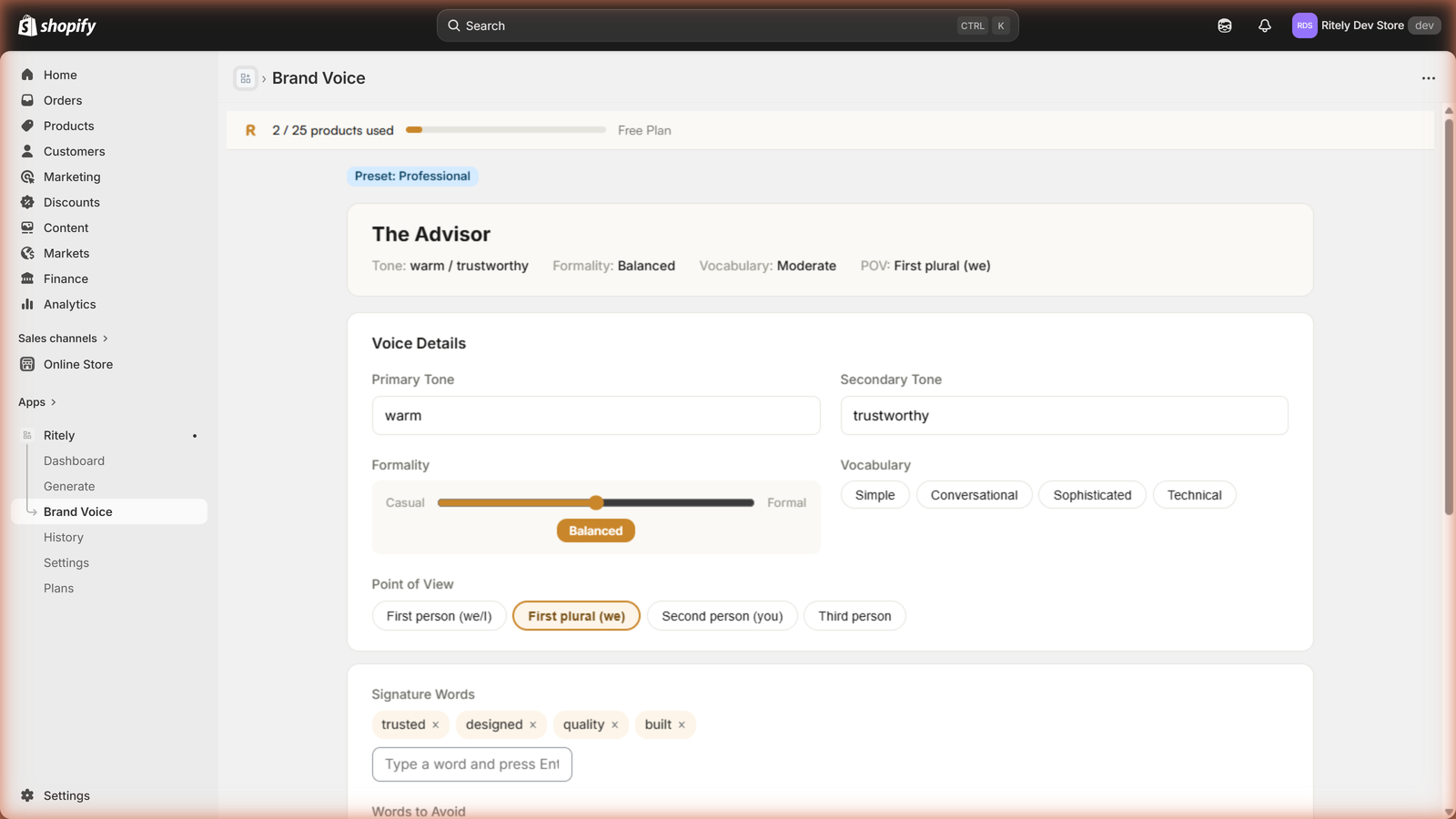
The right AI tool should let you upload your brand voice (examples, guidelines, written statement) and then apply it consistently across your catalog. When you’re writing descriptions for 500 products or refreshing them seasonally, you can’t maintain quality without automation. But you also can’t sacrifice voice. For a closer look at how AI tools actually use voice profiles, see why brand voice is the missing piece in AI product descriptions.
Here’s what to look for in an AI tool for brand voice:
1. Can you upload examples? The tool should learn from your actual descriptions, not just your written guidelines.
2. Does it handle research? A description that sounds like you but is factually wrong helps nobody. The tool should search for real product information and weave it in.
3. Can you review before publish? AI will still make mistakes. You should be able to see and edit every description before it goes live.
4. Does it maintain voice across variations? If you’re writing 3-5 descriptions per product (short, long, benefit-focused, feature-focused), they should all sound like your brand, not like five different writers.
5. Can you refine mid-project? The first 20 descriptions set the tone. When you realize the AI is reading your voice wrong, you should be able to correct it and re-run without starting over.
Without these capabilities, you’ll end up editing almost every description anyway. Which defeats the purpose. If you’re evaluating tools, our merchant’s guide to AI product descriptions walks through how these pipelines actually work and what separates a good tool from a generic one.
Your Next Step
You don’t need a fancy brand strategy consultant to define your voice. You need honesty about who your customer is and how you actually talk to them.
Work through the worksheet. Write your voice statement. Run the swap test. If you can tell the difference, you’re ready to scale. If you can’t, you’ve at least learned what’s missing. Once your voice is defined, our guide to writing product descriptions that convert shows how to apply it at the product level.
The stores that win on Shopify aren’t winning because they have the best products. They’re winning because they sound like themselves. Your customer can feel the difference between a store that’s trying to be everything and a store that knows exactly who it’s for.
Your voice is that difference.