The state of AI product descriptions in 2026
Two years ago, AI product descriptions were a novelty. Today, they’re table stakes. Every major ecommerce platform now offers some form of AI-powered copy generation, and thousands of Shopify stores are using it daily.
What changed? Speed, sophistication, and scale. In 2024, AI description tools were mostly wrappers around GPT-3.5. They took a product name and maybe a category, and generated a single block of text. Hit-or-miss quality. Expensive per unit.
Now, in 2026, the landscape has fragmented. You have:
- Built-in tools like Shopify Magic, which come free with your store and understand your product data
- Specialized Shopify apps that handle bulk generation, multiple variations, image analysis, and brand voice
- General-purpose LLMs like ChatGPT, which let you write your own prompts but require manual copy-paste
- Custom workflows that integrate AI with your internal processes (inventory systems, brand guidelines, design assets)
The real shift is in capability. Today’s AI can look at product images, understand what it’s seeing, research context (materials, competitor positioning, trend relevance), generate multiple variations, and even score its own work. This is why merchants are moving from “should I use AI?” to “which AI tool should I use?”
How AI description tools actually work
To pick the right tool, you need to understand what’s happening under the hood. Not the PhD-level math, but the architecture that affects your results.

The LLM base. Most tools use one of three language models: GPT-4 (OpenAI), Claude (Anthropic), or Gemini (Google). Each has different strengths. GPT-4 is the industry standard for creative writing. Claude is known for longer-form reasoning and following complex instructions. Gemini is cheaper and integrates with Google services. This choice matters more than marketing will tell you. A tool built on Claude will often outperform one built on GPT-3.5, even if they have the same interface.
Prompting vs. fine-tuning. Cheaper tools use fixed prompts: “Write a product description for [product name].” More sophisticated tools let you define brand voice upfront, then reference it in every generation. The best tools go further: they fine-tune or adapt the model based on your approved descriptions, so it learns your voice over time.
Agentic pipelines. This is the newest pattern. Instead of generating a description in one shot, the AI breaks the task into steps: (1) assess what I know and don’t know, (2) research the product (look up materials, competitor claims, industry standards), (3) analyze images to see materials and quality cues, (4) generate multiple variations, (5) review its own work against brand guidelines. This pipeline can run multiple models at different steps (maybe Claude for thinking, GPT-4 for creativity, a smaller model for review). The result is more accurate, better-matched to your brand, and less often wrong in ways that hurt trust.
Image understanding. Older tools took text input only. Now most can analyze product images. This matters because photos show material, finish, size context, and visual style that text descriptions miss. A competent AI that sees the image will mention “brushed stainless steel” instead of just “metal,” and it won’t claim a matte finish on a glossy product.
What AI does well
Speed. The most obvious win. A merchant with 500 products can generate first-draft descriptions in hours instead of weeks. Even if you plan to review or edit each one, the baseline productivity jump is massive.
Consistency. If you write 50 descriptions yourself, some will be 80 words, some 300. Some will emphasize features, others benefits. AI enforces a template. This sounds limiting, but it’s actually valuable for SEO, scannability, and brand coherence. Every product feels like it belongs in your store.
SEO optimization. Modern AI tools understand keyword density, structure, and readability scores. They can incorporate SEO keywords naturally (no keyword stuffing), use H-tags in formatting if needed, and match word count to what ranks for your product category. A human writer can do this too, but AI is systematic about it.
Scaling to bulk inventory. Generate 100, 500, or 5,000 descriptions in one batch. Whether you’re onboarding a new supplier, migrating from another platform, or refreshing your entire catalog, AI can handle volume without fatigue or inconsistency.
Handling commodity products. If you sell generic t-shirts or phone cases where the real differentiation is your brand, AI is especially useful. It won’t invent features, but it will highlight material, sizing, fit, and durability in a way that supports your positioning. For unique, niche products, it struggles more (see below).
What AI still struggles with
Factual accuracy without verification. AI hallucinates. It will confidently claim a cotton shirt is “breathable and moisture-wicking” when the source material says “35% polyester.” It will invent product features. The best tools mitigate this by (1) using your own product data as ground truth, (2) allowing image analysis to catch obvious mismatches, and (3) flagging uncertain claims for human review. But you still need to spot-check.
Truly creative copy. AI is good at variations, but bad at breakthroughs. If your brand voice is witty, provocative, or deeply personal, AI will produce competent copy that sounds like 100 other stores. It can’t replicate the voice of a founder who writes like themselves. It’s especially weak at humor that depends on context or irreverence.
Niche expertise and nuance. A craftsperson who makes hand-forged kitchen knives has 15 years of knowledge about steel composition, heat treatment, and blade geometry. AI trained on general ecommerce data doesn’t have that depth. It will generate correct-sounding copy that misses the real differentiator. For highly specialized products, AI is a starting point, not a finished product.
Emotional storytelling. AI can write “this pillow is perfect for side sleepers” but struggles with “this pillow changed how I sleep,” the kind of human narrative that builds loyalty. It can’t channel the story behind why you make something.
Understanding your actual customer. Generic AI doesn’t know if your buyer is a 22-year-old new parent, a 55-year-old enthusiast restocking, or a B2B buyer. It doesn’t know your store’s positioning or tone. Tools that integrate your brand voice, past descriptions, and audience data perform much better.
Types of AI tools for product descriptions
Built-in: Shopify Magic. Comes free with Shopify. Integrates directly with your product editor. No additional login or tool switching. Works from product title, category, and image. Decent baseline quality, especially for common categories. Updated in early 2026 with brand-aware tone options. For a detailed head-to-head comparison, see our Shopify Magic vs. Ritely guide. Best for: merchants who want zero friction, small catalogs, or products with strong category patterns.
Dedicated Shopify apps. Specialized tools that live in the Shopify App Store. Examples include Profitonium, StoreYa, and Youssify — see our full comparison of the best AI description apps for detailed reviews. These offer more control: bulk generation, brand voice customization, multiple variations, image analysis, and refinement loops. Usually priced per product generated or per month. Best for: merchants with 100+ products, specific brand voice requirements, or need for advanced features like multilingual generation.
General-purpose LLMs. ChatGPT, Claude, Gemini. You write the prompt, you paste the product info, you copy-paste the output. No integration, but maximum control. Free (with limitations) or cheap ($15-20/month). Best for: technical merchants comfortable with prompting, small catalogs, or testing before buying a dedicated tool.
Custom workflows. API access to Claude or GPT-4, run on your own infrastructure. You decide the pipeline: pull product data from your ERP, combine with brand guidelines, call the model, store results in your database, surface for review. Most powerful, steepest learning curve. Best for: developers, enterprise scale, or highly specialized use cases.
How to evaluate an AI description tool
Brand voice support. Can you define your tone upfront? Can the tool apply it consistently across generations? Does it learn from your approved descriptions? Red flag: tool asks you to define voice but ignores it in output.
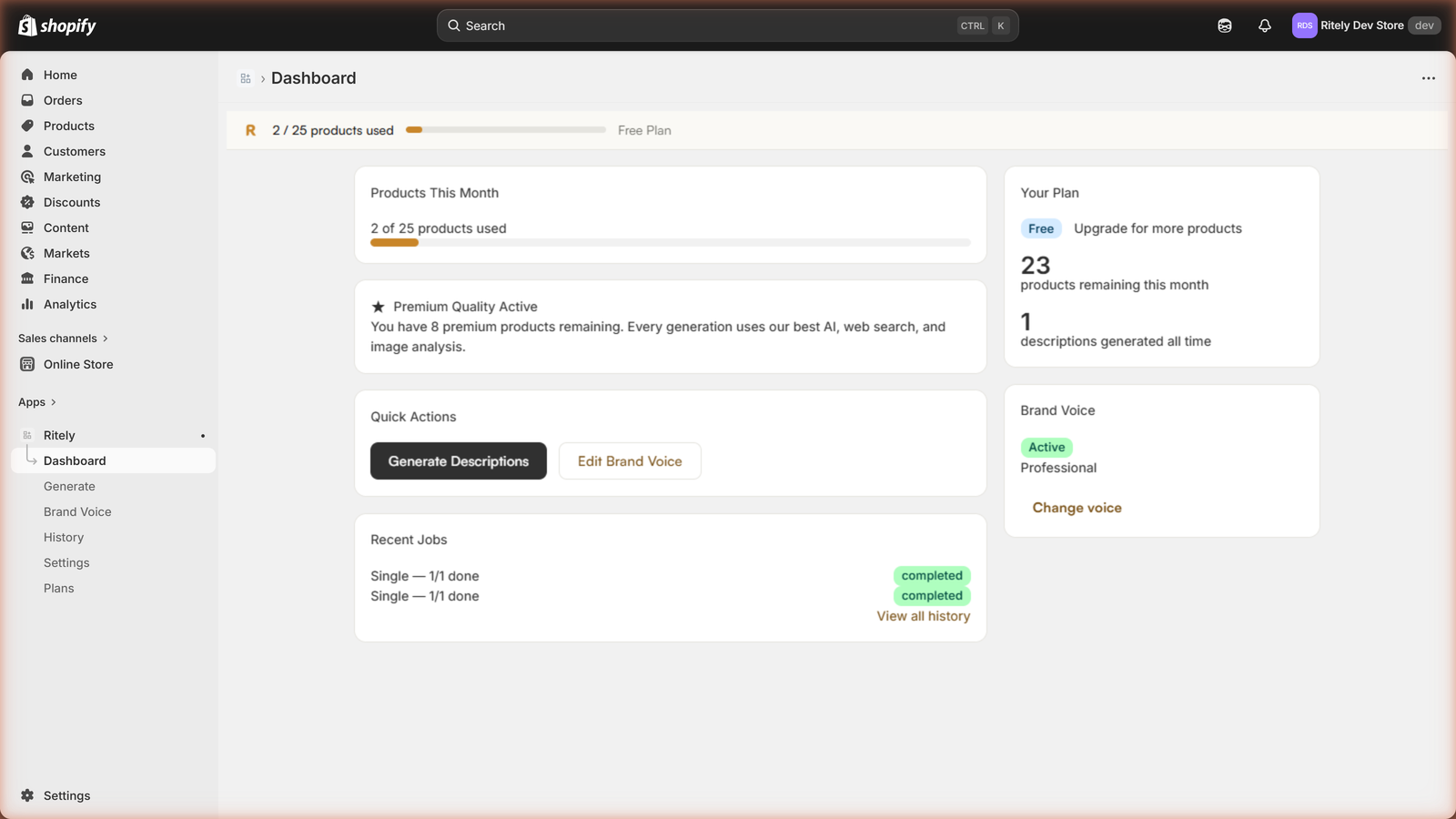
Bulk generation. Can you generate 50 or 500 descriptions at once, or only one at a time? Does it show progress? Can you pause or cancel? How long does it take?
Image understanding. Does the tool analyze product images? Does it mention materials, condition, and visual details? Test with a leather jacket photo and see if it notices the stitching or hardware.
Variations and review. Can you generate 3-5 versions of the same description and pick the best? Can you request refinements without re-running the whole pipeline? Is the review process intuitive?
Pricing and limits. Per-product? Per-month? Free tier? What happens when you exceed limits? Is a 50-product test run cheap enough to validate before committing?
Output quality on YOUR products. Don’t trust the marketing. Generate descriptions for 5-10 real products from your catalog. Read them carefully. Are they accurate? Do they match your voice? Would you publish them as-is or need significant edits?
Integration. Does it work inside Shopify, or require export/import? Does it integrate with your brand asset files (logos, style guides)? Can it pull data from your inventory system?
Getting the best results from AI descriptions
Input quality matters more than tool choice. A premium AI tool fed “blue shirt” will generate generic output. The same tool fed “Indigo linen shirt, 100% pre-washed linen from Portuguese mills, unstructured cut for oversized fit, durable shell buttons, released in limited quantities monthly” will nail it. Invest in data quality: complete product info, good photography, material specs, sizing charts.
Set up brand voice upfront. Before generating your first description, define voice. Don’t write a paragraph. Write 2-3 existing descriptions you’re happy with and feed them to the tool. Or provide brand guidelines: “We write for DIY homeowners, not architects. Emphasize ease and cost. Tone is encouraging, practical, occasionally playful. Avoid jargon and brand names.”
Review as a workflow, not a filter. Don’t generate 100 descriptions and then review all 100. Generate 10, review them, refine your inputs or settings based on what you learned, then generate the next batch. This loop is faster and produces better results than batch-and-pray.
Use variations, not overwriting. Generate 3-5 versions of the same description. Read all of them. Often the best version is a hybrid: paragraph 1 from version A, paragraph 2 from version B, final line from version C. Most tools support this.
Fact-check strategically. You can’t verify every claim in every description. Instead, spot-check by category: pick a random sample from apparel, another from home goods, etc. Look for hallucinations (invented features), missing details (unstated materials), and tone mismatches. Use these findings to adjust your prompt or tool settings.
A/B test if you can. If your platform supports it, publish descriptions from different tools or generations to different products, then compare sales and engagement. After a few weeks, you’ll know which output style converts for your audience.
The real cost comparison
Manual writing. You write descriptions yourself. Cost: your time. Typical: 15-30 minutes per product, so 500 products = 125-250 hours. At a loaded cost of $50-100/hour (including overhead), that’s $6,250-25,000. Plus fatigue, inconsistency, and the opportunity cost of time spent here instead of strategy or customer engagement.
Freelance writers. Hire a copywriter at $20-50 per description (rush charges higher). 500 products = $10,000-25,000. You get quality and consistency but lose control over timeline and budget certainty. Good copywriters are booked months out.
AI tool, free tier. Tools like Shopify Magic or ChatGPT GPT-4o mini are free or nearly free (ChatGPT Plus is $20/month for unlimited usage of GPT-4o mini). 500 products costs maybe $20-100 total. Tradeoff: no bulk generation, limited brand voice control, you need to review everything.
AI tool, paid app. Dedicated Shopify apps range from $20-200/month depending on generation volume and features. For 500 products: roughly $100-500 one-time investment. Typical payoff: saves 100+ hours of writing and review time, breaks even in 1-2 weeks.
Hybrid: AI + light review. Generate descriptions with an AI tool, then spend 5-10 minutes per product light-editing (fixing one fact, tightening a paragraph, adjusting tone). For 500 products: 40-80 hours at $50/hour = $2,000-4,000 in labor, plus tool cost. Much cheaper than full freelance or manual writing, way faster than either, and quality is high because every description gets human eyes.
The math almost always favors AI + review over manual writing or freelance, unless you have only 20-30 products or your copy is truly a core differentiator.
When NOT to use AI for descriptions
When product features are contested or complex. If a supplement claims to “boost immunity” or a skin product claims to “reduce acne,” regulatory bodies (FDA, FTC) care about precision. AI can invent claims that expose you to liability. Manual review is essential, and relying on AI here is risky.
When your voice is a core brand asset. If your brand is founder-led, personality-driven, or deliberately irreverent (think DTC startups), AI will sanitize your voice. It’s technically competent but strategically wrong.
When dealing with highly specialized products. Bespoke furniture, artisanal goods, or products with deep technical specs (camera lenses, synthesizers) benefit from writer expertise that AI doesn’t have. Use AI as a draft, but plan on 30-50% rewriting.
When you’re unsure what makes your product different. AI is a mirror of input. If you can’t explain why your product is better than ten competitors, AI won’t either. Clarify your positioning first — our guide on how to write product descriptions that convert can help.
The future: what’s coming next
Three things are on the horizon.
Real-time brand learning. Tools are moving toward continuous learning: every description you approve teaches the model a bit more about your voice. By description 50, it should sound indistinguishable from your writing. By description 500, it should anticipate your preferences before you state them.
Multimodal understanding. Today’s best tools analyze product images. Tomorrow’s tools will analyze competitor websites, your brand guidelines (as visual design, not just text), customer review sentiment, and sales data in parallel. The description will be optimized not just for brand but for what actually sells in your category.
Agentic workflows as default. The research-assess-generate-review pipeline will become standard, not premium. Expect every tool by 2027 to automatically research related products, fact-check its own claims, and flag uncertain outputs for review. This will push accuracy from “usually right” to “right 95% of the time.”
For now, the takeaway is: AI for product descriptions is mature enough to save you time and money, but immature enough that you still need to review and edit. This is not a “set it and forget it” category.