You need product descriptions. ChatGPT can write them. You know this. The question isn’t whether ChatGPT can do the job—it can, and it does it well. The question is whether it’s the right tool for your workflow.
If you’re running a Shopify store, the answer depends on your catalog size, your team, and how much you value your time. Let’s walk through it honestly.
The appeal of ChatGPT
ChatGPT has three genuine advantages:
It’s free (or cheap). ChatGPT Plus is $20/month. No per-product fees, no monthly commitments, no tiers that bump you up when you hit some usage threshold. You can generate 100 descriptions for the cost of ChatGPT Plus for a month.
It’s flexible. You can write a prompt for almost any style, tone, or format. Want descriptions in the style of a sneaker brand? Write a prompt. Want them optimized for a specific keyword? Paste it in. Want descriptions that lead with the problem your product solves? ChatGPT will do that too. You’re not locked into a platform’s preset templates or brand voice frameworks.
It’s powerful. ChatGPT’s writing quality is genuinely good. It understands context, can incorporate technical specs, and writes copy that converts. For individual descriptions, it often beats what you’d write yourself on the third coffee of the day.
For many people, that’s enough. The math works.
Where ChatGPT falls short for ecommerce
But here’s what ChatGPT doesn’t do:
It doesn’t integrate with Shopify. ChatGPT lives in a browser tab. Your product data lives in Shopify. You have to copy product details from Shopify, paste them into ChatGPT, write the prompt, generate the description, copy the output, go back to Shopify, find the product again, paste the description into the right field, and save. Repeat 50 times. Repeat 500 times if you’re launching a new category.
It has no memory of your brand voice. You can write a detailed prompt about your brand’s tone, values, and style. But ChatGPT won’t remember it tomorrow. You’ll either paste the same prompt 100 times, or your descriptions will drift. By description 50, they’ll sound different. By description 100, they might not sound like your brand anymore.
It can’t generate in bulk with consistency. You can’t point at your entire winter collection and say “write descriptions for all 200 of these.” You write them one at a time. Or you batch them and accept that quality will vary. Or you spend hours refining a system to make it work better. The workflow breaks at scale.
It doesn’t have access to your product data. ChatGPT doesn’t know your inventory levels, variants, pricing, or what’s trending in your shop. You have to manually add that context to every prompt. A dedicated app can read your Shopify data automatically and incorporate it.
It can’t publish directly to Shopify. Every description has to be manually added to your store. There’s no bulk upload, no queue, no “apply to all variants” option. You’re copy-pasting into forms one product at a time.
For a store with 20 products, this might not matter. For a store with 100 products, it becomes tedious. For a store with 500 products, it becomes a project that takes weeks.
What dedicated Shopify apps add
A dedicated product description app solves those workflow problems:
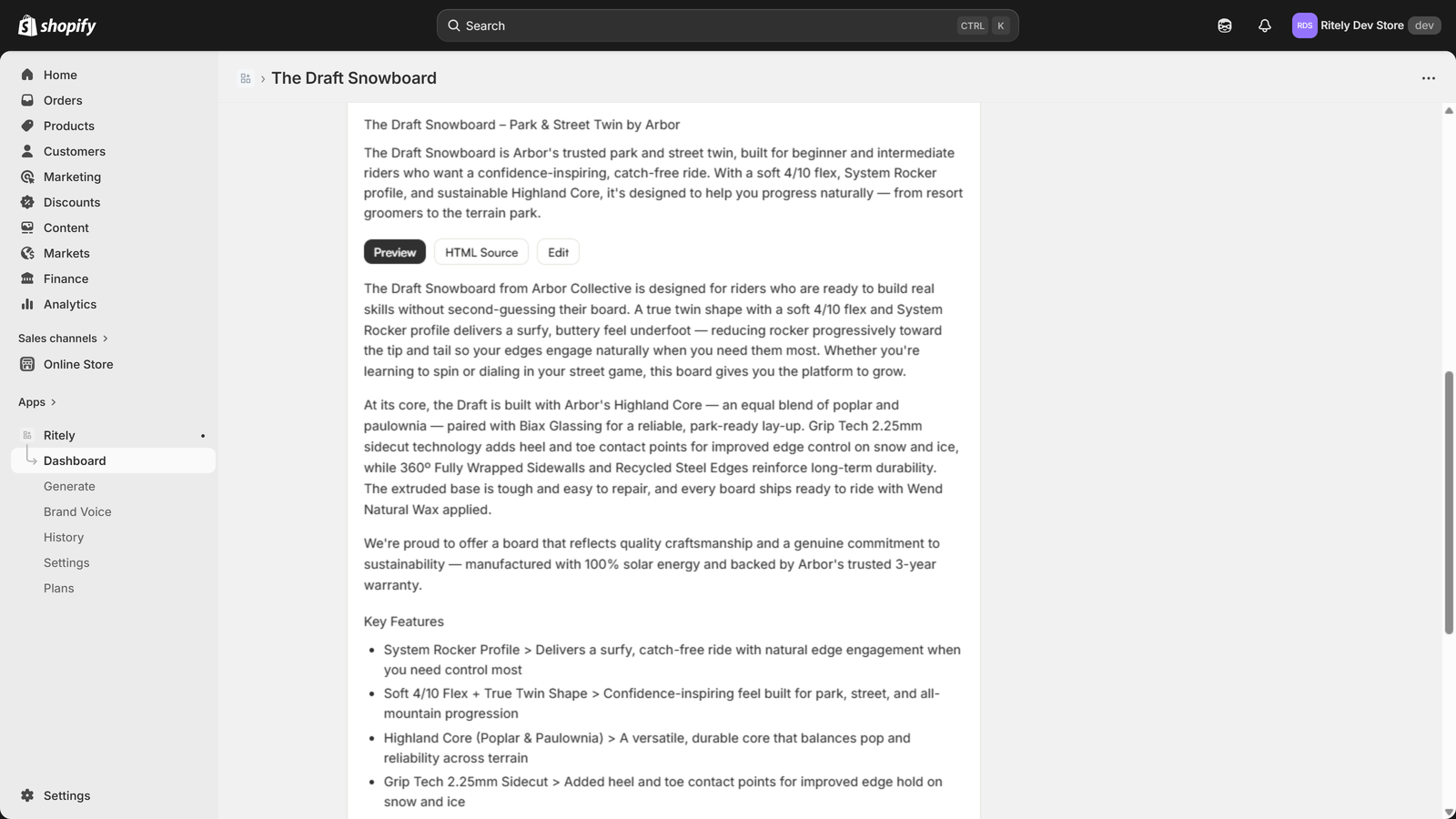
It lives inside Shopify. You don’t tab-switch. You select products, click a button, and descriptions generate in your Shopify admin. The friction drops to nearly zero.
It learns and remembers your brand voice. You set it once—through materials, a questionnaire, or a preset—and it applies consistently across every description. Your winter collection sounds like your spring collection. Your new staffer’s descriptions sound like your founder’s.
It generates in bulk. Select 50 products. Click generate. Come back in two minutes. All 50 have descriptions. No one-at-a-time workflows. No batching compromises.
It reads your product data automatically. Title, tags, variants, pricing, collections—the app pulls it all in. Your descriptions are informed by your actual product data without you having to copy-paste anything.
It publishes directly to Shopify. One-click approval, and descriptions are live. Or batch-approve dozens at once. No manual entry required.
It can enforce consistency. Every description follows the same structure, length, and brand guidelines. You won’t get surprise outputs that are too long or too informal. The app knows your standards and enforces them.
The hidden cost of “free”
ChatGPT is cheap. But “cheap” isn’t the same as “free” when you factor in time.
Let’s do the math. Say you’re a mid-size Shopify store with 200 products that need descriptions. ChatGPT takes about 2-3 minutes per description once you factor in copying specs, writing the prompt, generating, reviewing, and copying it back into Shopify. That’s 400–600 minutes. Call it 10 hours of your time.
A dedicated app takes about 20 seconds per product once you set up your brand voice (10 minutes setup time). That’s about 70 minutes total. Call it 1.5 hours.
You’ve saved 8.5 hours. If your hourly rate is anything above $0, that time has value. At $50/hour, you’ve saved $425 worth of time. A monthly subscription to a description app might cost $15–40. The math already favors the app.
But time isn’t the only cost. There’s also the cognitive load of switching between apps, the risk of inconsistency, and the friction that builds every time you need to regenerate a description or add a new product.
When ChatGPT is the right choice
That said, ChatGPT is the right tool in certain situations:
Small catalogs (under 50 products). If you’re not adding products frequently and your catalog is small, the time savings of an app barely matter. ChatGPT is simpler and cheaper.
Experimentation and testing. If you’re figuring out your voice, testing different styles, or learning what converts, ChatGPT’s flexibility is an advantage. You can iterate quickly without being locked into an app’s constraints.
One-off or seasonal updates. Adding 20 products to a winter collection? ChatGPT is faster than setting up an app you’ll use once. Do the work, move on.
Non-standard workflows. If you need descriptions in a format that doesn’t fit typical Shopify tools, or if you need to integrate them with another system (a PDF catalog, an email campaign, a print brochure), ChatGPT’s flexibility wins.
Custom prompt development. If you’re building a bespoke system and want full control over how prompts are structured, ChatGPT is your sandbox.
When a dedicated app makes more sense
A dedicated Shopify app wins when:
Your catalog is growing. More than 100 products? An app pays for itself in time savings alone. More than 500 products? An app becomes essential.
You need consistency at scale. If your brand’s voice and style matter, and you need every description to reflect that, an app enforces it automatically. ChatGPT requires discipline and repetition.
You have a team. If multiple people are writing descriptions, an app ensures everyone uses the same voice and process. ChatGPT requires shared prompts and coordination.
You add products regularly. If you’re launching new products weekly or monthly, the friction of ChatGPT’s workflow compounds. An app becomes part of your standard process.
Speed matters. Bulk generation in seconds, with one-click publishing, beats manual copy-paste every time when you’re on deadline.
You want AI-powered research. Some dedicated apps can search the web for competitors’ descriptions, research your product category, or analyze your brand materials. ChatGPT needs you to do all that research manually.
The honest middle ground
Here’s what most successful stores do: They use ChatGPT for experiments and one-offs, and a dedicated app for the bulk of their work. The app handles the repetitive, high-volume work. ChatGPT handles the edge cases and special projects.
The key is recognizing when you’ve crossed the threshold where an app makes sense. It’s not about the cost of the tool. It’s about the cost of your time and the value of consistency.
If you’re spending more than 2–3 hours per month generating descriptions, a dedicated app will pay for itself. If consistency across your catalog matters to your brand, an app is almost certainly worth it.
ChatGPT is a powerful tool. But it’s a solo tool. When you need to integrate description writing into a team workflow and apply it at scale, a Shopify app bridges that gap.
The question isn’t “Can ChatGPT write descriptions?” The answer is yes. The question is “Is copy-pasting the best way to scale this?” Almost never.
For more on writing descriptions that actually convert, see our guide on how to write AI product descriptions, or check out the best AI product description apps for Shopify. And if you’re writing manually, our guide to Shopify product descriptions has tactics that work regardless of your tool.